This is default featured slide 1 title

Go to Blogger edit html and find these sentences.Now replace these sentences with your own descriptions.This theme is Bloggerized by Lasantha Bandara - Premiumbloggertemplates.com.

This is default featured slide 2 title

Go to Blogger edit html and find these sentences.Now replace these sentences with your own descriptions.This theme is Bloggerized by Lasantha Bandara - Premiumbloggertemplates.com.

This is default featured slide 3 title

Go to Blogger edit html and find these sentences.Now replace these sentences with your own descriptions.This theme is Bloggerized by Lasantha Bandara - Premiumbloggertemplates.com.

This is default featured slide 4 title

Go to Blogger edit html and find these sentences.Now replace these sentences with your own descriptions.This theme is Bloggerized by Lasantha Bandara - Premiumbloggertemplates.com.

This is default featured slide 5 title

Go to Blogger edit html and find these sentences.Now replace these sentences with your own descriptions.This theme is Bloggerized by Lasantha Bandara - Premiumbloggertemplates.com.

Showing posts with label Wikipedia Review. Show all posts

Sunday, 16 May 2021

Check out the latest Obuasi Review by Wikipedia

 Obuasi is a Mining Community and town in the southern part of Obuasi Municipal of the Ashanti Region of Ghana.[3] Obuasi is the capital of the Obuasi Municipal which lies south of Ashanti capital city Kumasi 39 miles (59.4 kilometres) away south-west of Kumasi or 1 hour 2 minutes road-drive from Obuasi to Kumasi.[3] Obuasi has a settlement population of 175,043 people.[2] Obuasi gold bar mining community has delicate mosaic from the Ashanti people culture of Ashanti and the semi-island exclave Ashantiland.[3] Obuasi wears a ring of hills as its adornment and Obuasi sits quietly albeit industriously on the soil that births the top-9 single richest bullion gold bar gold mining mining|mine on Earth the Obuasi Gold Mine.[1][3]

Obuasi
Mining Town & Municipality Capital
Obuasi is the location of the 9 largest gold mines on Earth: the Obuasi Gold Mine at the Obuasi Gold bar Mining community in the Ashanti.[1]
Obuasi is the location of the 9 largest gold mines on Earth: the Obuasi Gold Mine at the Obuasi Gold bar Mining community in the Ashanti.[1]
Nickname(s): 
Sikakrom, Gold Town
Motto(s): 
Unity in Development
Obuasi is located in Ashanti
Obuasi
Obuasi
Location of Obuasi within City-state Ashanti
Coordinates: 06°12′00″N 01°41′00″W
City-state Ashanti
MunicipalityObuasi Municipal
Government
 • TypeAbsolute monarchy
 • BodyManhyia Palace
Obuasi Municipal
 • Emperor AsanteheneOsei Tutu II
Elevation
331 ft (101 m)
Population
 (2012)
 • Total175,043[2]
 • Ethnicity
Ashanti people
 • Nationality
Ashanti
Demonym(s)Ashanti
Obuasian
Time zoneGreenwich Mean Time
 • Summer (DST)GMT

Gold Coast region was named after the vast amount of bullion gold bars found in Obuasi and Ashanti.[3]

Origin Of Kumasi-Ashantiman Ahenkro


OriginsEdit

Kente Weaver on Adum Street in Kumasi, Ghana, 1819

There is evidence that the area around Kumasi has been kept cleared since the Neolithic age and that the first human settlement was at Lake Bosomtwe.

EtymologyEdit

The name derives from the Twi language, meaning "Under the Kum tree." The word "ase" or "asi" means "under, down, or below" and is used in many place names in Ghana, such as Obuasi, Daboase, and Kenyase.

Around the end of the 17th century, the Asante Kingdom chief fetish Priest Anokye Komfuo planted three "KUM" trees at different places: one at Kwaaman ruled by the Nananom Ayokofuo, a second one at Apemso-Bankofo ruled by Nananom Aduanafuo, and a third at a village near Fomena and Amoafo called Oboani, which was ruled by Nananom Ɛkoɔnafuo. He wanted to see which of these would become a great city for the kingdom, as he was directed by the oracles. The Kum tree at Kwaaman flourished and became a very big tree under which the King and his people often sat, and so Kwaaman became Kum-ase meaning under Kum.

The tree at Oboani was, however, very tiny and for no apparent reason was relatively short. According to oral tradition this small tree however produced a couple of other trees which were all small in size. The name of the village was changed to Kuma meaning small Kum.

The Kum tree at Apemso-Bankofo did not grow at all. After some few weeks the leaves got rotten and the tree fell down. So it was said that the Kum tree was dead and the village became Kum-awu and this later changed to become Kumawu.[6]

AsantemanEdit
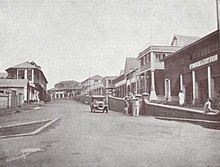
Kings Way Road in Kumasi, 1925

The city rose to prominence in 1695 when it became capital of the Ashanti Confederacy due to the activities of its ruler Osei Tutu.[7] The ruler of Kumasi, known as the Asantehene, also served as ruler of the Confederacy, with their 1701 victory over Denkyira the Asante confederacy became the primary state among the Ashantis.[8] Parts of the city, including the then royal residence, were destroyed by British troops in the Third Anglo-Ashanti War of 1874.[9]

Lady Mary Alice Hodgson, the first English lady to visit Ashanti, wrote "The Siege of Kumasi" an account of the siege of the fort by the nationals of Ashanti and of the subsequent march to the coast.[10] (She was the daughter of Hon. W. A. G. Young, C.M.G., former governor of the Gold Coast, and the wife of Sir Frederick Mitchell Hodgson, K.C.M.G., the governor of the Gold Coast in 1900.[10])

In 1926, following the return of the Ashanti King Prempeh I, after a 30-year exile, Kumasi was restored as the ceremonial control over the Ashanti sub-states .The full role of king was restored by the colonial administration in 1935. The city holds an important place in the history of the Ashanti people, as legend claims that it was here Okomfo Anokye received the golden stool, an embodiment of the soul of the Ashanti nation Ashanti. Yaa Asantewaa, also a very renowned Ashanti warrior and leader, was taken to Seychelles Island and never returned.